21 Nov 2026 · 4 min read
4 Words Every 3D Junior Must Know Before Their First Client
Brief, guideline, deadline and workflow: what each word means on a real 3D client job, with sources that back it, a free practice brief and a prompt that turns ChatGPT into a tough client.
A Junior finished his Blender and AI courses, and still nobody's hiring him. A calm Senior tells him why: tools alone are not enough. You need a mindset, and four words that every real client job runs on. Here they are, each backed by a source, plus a free practice brief to start today.
1. Brief: what the client wants
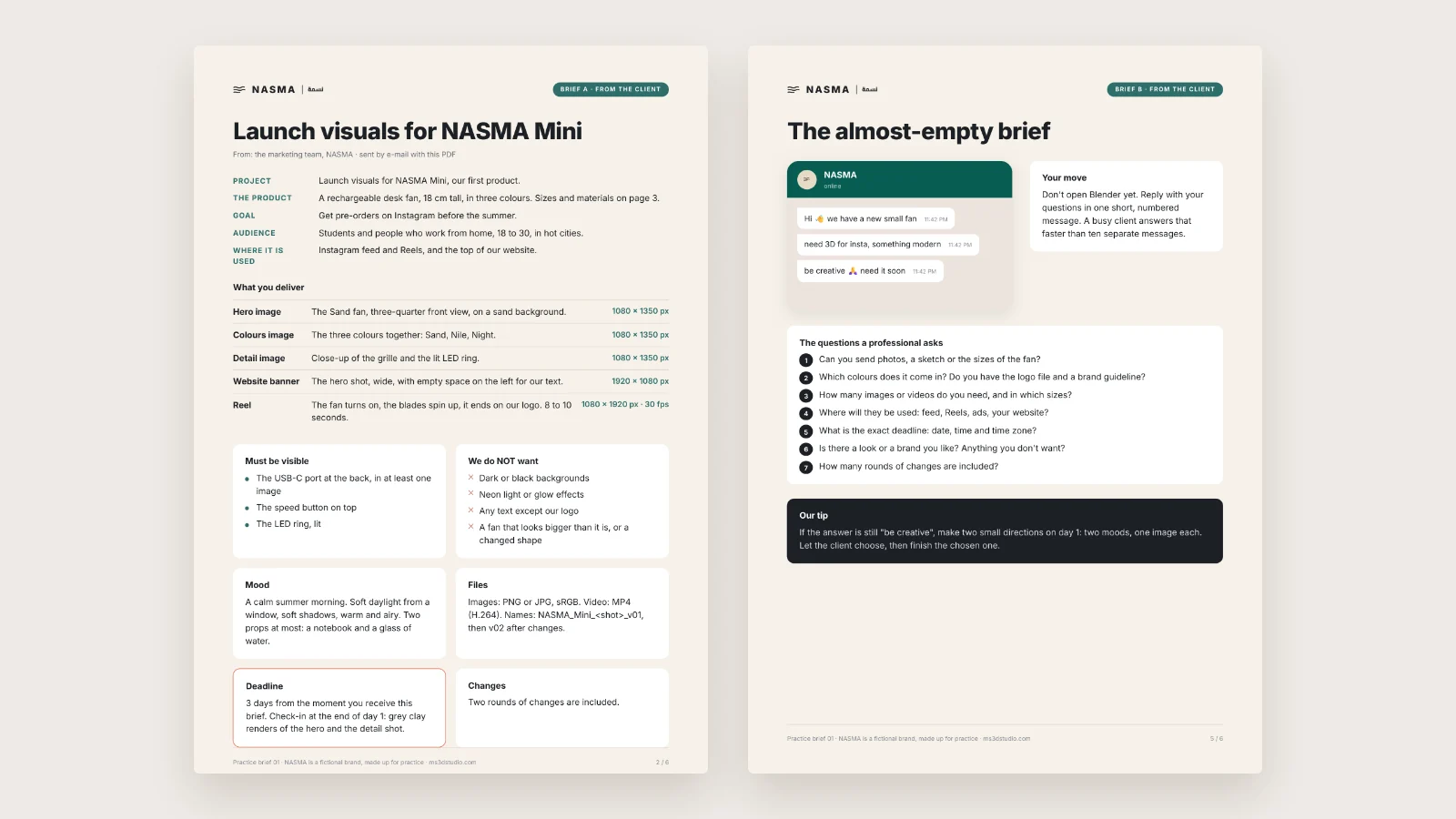
"The short version of the idea the client wants." A professional client writes every detail on WhatsApp, or sends a PDF or a PowerPoint with pictures. Another just says: "I want a booth for my product... be creative."
Weak briefs are normal, even at big companies: 80% of marketers think they write great briefs, and only 10% of agencies agree (Strategy, 2022). So when a brief is thin, ask before you start, in one short message:
- The product: real sizes, materials, colours?
- What to deliver: how many images or videos, in which sizes?
- Where will it be used, and for whom?
- The exact deadline, and how many rounds of changes?
2. Guideline: how the brand must look
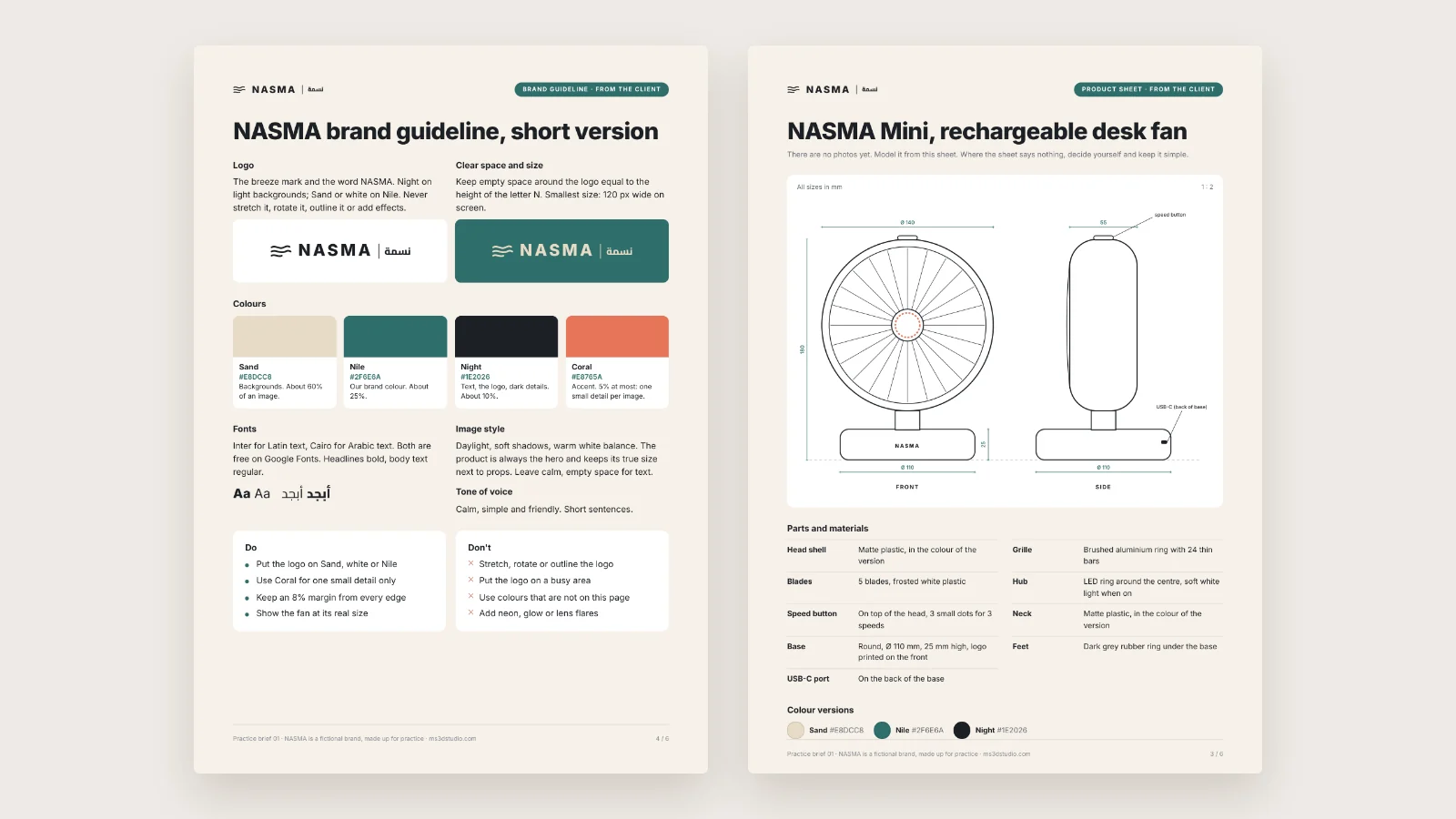
"Every serious company has a big PDF with everything about it": "the logo and how to use it... the colors they always use, and how to work them into your design."
"And if the client doesn't have a guideline?" "That's fine. He doesn't have to." Many don't: 69% of companies say their brand guidelines aren't widely used or don't exist at all (Marq). Then ask for the logo file and the colours, and keep them the same in every image. To see a real one, open the NASA Graphics Standards Manual from 1976.
3. Deadline: when you deliver
"Some projects are due the same day... some in two or three days... some take a month, or a year." "A year?!" "Yep. And either way, you stick to it."
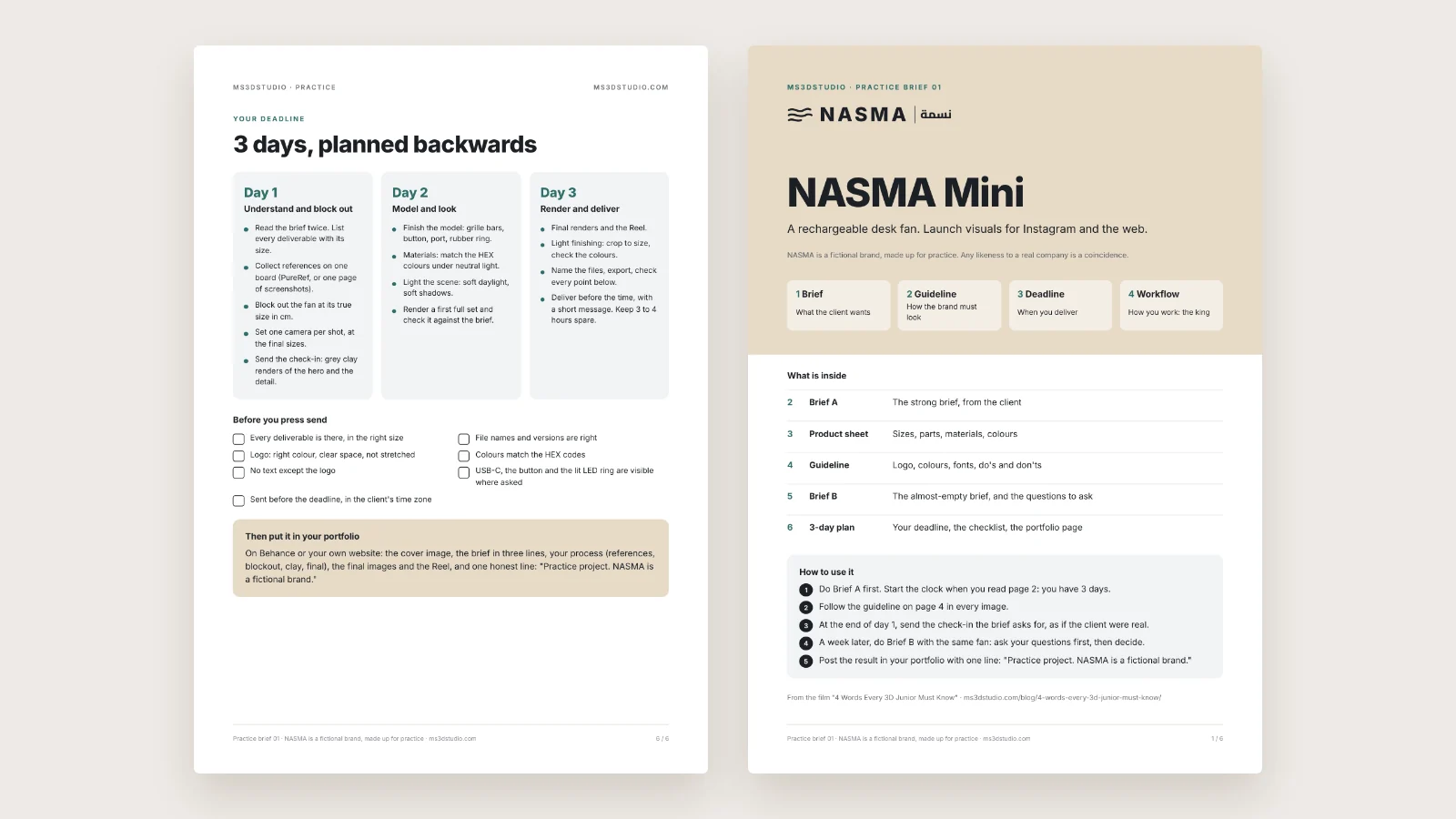
On freelance sites your record is public. On Fiverr, a late order affects your on-time delivery score, so tell the client as early as you can and ask for an extension (Fiverr Help Center). Write down the date, the time and the time zone, and send a grey clay render on day one: a wrong direction then costs an hour, not a day.
4. Workflow: the king of them all
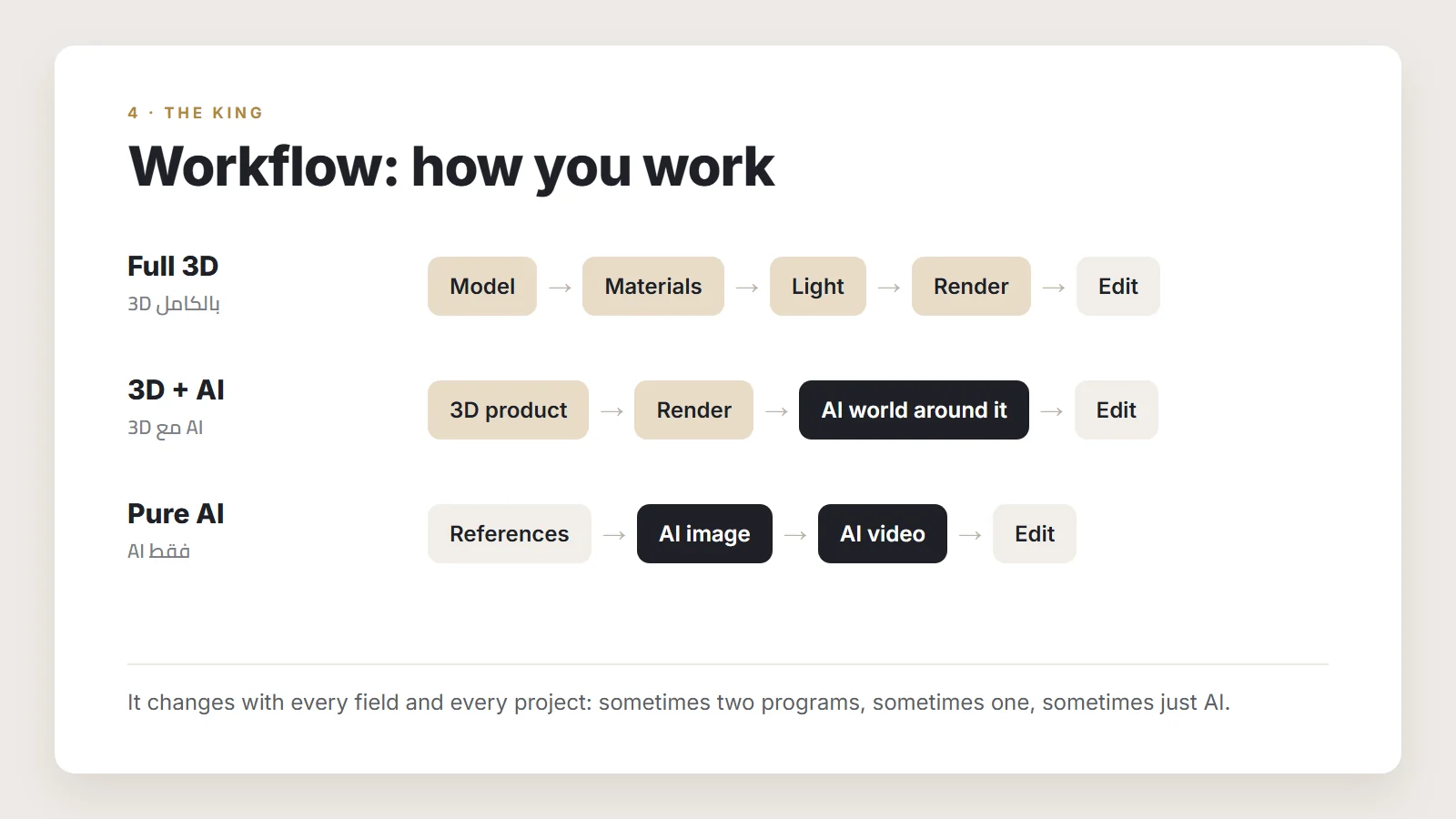
"The king of them all: the workflow. How you work." "It changes with every field and every project... sometimes two programs, sometimes one, sometimes just AI." Schools that train 3D artists say the same: each project is unique, and pipelines vary by company, studio and software (ESMA).
A product visual can be full 3D in Blender, a quick social ad can be pure AI, and many jobs mix both. We explain how we choose in 3D, AI or both?
Challenge yourself with a tough AI client
"First advice: focus on one direction you love." Specialists keep improving at one thing, and that can raise their rate and the demand for them (CG Spectrum).
"And the most important one: challenge yourself." Paste the prompt below into ChatGPT or Claude. It plays a tough client who checks every tiny detail: it gives you a strong brief or almost none, a written guideline and a three-day deadline, then reviews your images or video point by point. Giving the AI a role really changes how it answers (Claude docs). To turn its written guideline into a PDF, use Canvas in Gemini (Google help); our Gemini prompt is in the downloads at the end.
Copy the prompt:
You are my CLIENT for a 3D practice project. I am a junior 3D artist training for real client work. Stay in this role for the whole chat.

WHO YOU ARE
- The owner or marketing manager of a small company that you invent. Invent a fictional brand and a fictional product. Never use a real brand, logo or product.
- You are demanding and you check every small detail: proportions, logo use, colours, light, reflections, file names and sizes. You are polite, but you never accept "almost right".

START
1. Ask me two things, then wait for my answers:
   a) Which field: product visualization, packaging, cosmetics, tech or gadgets, furniture, archviz, or "you choose".
   b) Which mode: STRONG BRIEF or NO BRIEF.

IF I CHOOSE "STRONG BRIEF"
Send one complete brief, like a professional client would, with:
- The brand and the product: what it is, real sizes in cm, materials, finishes and colour versions.
- The goal of the visuals and where they will be used (Instagram feed, Reels, website, print).
- The audience.
- The deliverables: how many images and/or videos, the exact sizes in pixels, the video length, the file formats.
- The shots that must be there and the details that must be visible.
- The mood: light, background, props, and three reference ideas written in words.
- What you do NOT want.
- The deadline: exactly 3 days from now, with a date, a time and a time zone, plus one check-in at the end of day 1 (a blockout or clay renders).
- The changes: 2 rounds.
Then send a BRAND GUIDELINE as text, with clear headings, so I can paste it into Gemini and turn it into a PDF: the logo (described in words: the wordmark, the icon, how it is drawn), the clear space around it and its smallest size, the colours with HEX codes and where each one is used, the fonts (free Google Fonts only), the image style, the tone of voice, and 5 do's and 5 don'ts.

IF I CHOOSE "NO BRIEF"
Write like a busy real client on WhatsApp: 2 or 3 short lines, for example "We have a new product, need 3D for Instagram, something modern, be creative, need it soon". Give no sizes, no colours and no guideline unless I ask for them. When I ask a good question, answer it in one short line. When I ask a vague question, give a vague answer. Never volunteer information. The deadline is still 3 days from your first message: tell me only if I ask.

WHEN I SEND WORK
- Check it against the brief and the guideline, point by point, like a strict art director.
- Give numbered feedback: what is wrong, where in the image, and what you expect instead. Be specific (for example: "the logo is too close to the edge", "the reflection on the cap is too strong", "the colour is #2F6E6A, yours is greener").
- Say clearly what you approve and what you don't.
- Never write "perfect" unless every point of the brief is met.
- After the second round of changes, say whether you would pay for this work or not, and why.
- If I miss the deadline, react like a real client.

RULES
- Reply in the language I write in (English or Egyptian Arabic).
- Keep each message short, like a real chat.
- Never step out of the role to teach me, unless I write "COACH". Then step out, tell me what a professional would do at this point, and go back to the role.Make it your own, then post it
"Even if the project's fake?" "Even if it's fake. And you don't have to redo a famous brand's work. Make your own concept." Practising on fictional briefs is a known way to build a first portfolio and get used to real clients (FakeClients).
"Every one of those projects becomes your portfolio, on Behance or a website with your name." Show only your strongest pieces, since a portfolio is judged by its weakest one (ArtStation Magazine), and add your process: recruiters want to see how the work was made (Hitmarker).
Sources
We opened and checked every source on 21 Nov 2026.
Brief
- Strategy: marketers think they write good briefs, agencies disagree (2022)80% of marketers think they write great briefs; only 10% of agencies agree. 1,700+ people in 70+ countries.
- IPA: the best way for a client to brief an agency (2022)UK marketers estimate that over a quarter of their marketing budget is wasted on poor briefs.
Guideline
- Marq: 30 branding stats and facts69% of companies say brand guidelines are not widely used or do not exist; colour raises brand recognition by up to 80%.
- NASA Graphics Standards Manual (1976)A real guideline to study: 60 pages on how to use the NASA logotype.
Deadline
- Fiverr Help Center: the order processA late order affects your on-time delivery score; expect a delay? Tell the client early and ask for an extension.
Workflow
- ESMA: the 3D animation pipeline, from concept to screenEach project is unique; pipelines vary by company, studio and software.
One direction
- CG Spectrum: do studios hire specialists or generalists?Focusing on one area lets you keep improving, and can raise your rate and demand.
- 80 Level: riches are in the niches, focus your craftTo stand out among other 3D artists, specialise.
Challenge yourself
- Claude docs: give Claude a roleSetting a role focuses the AI's behaviour and tone; even one sentence makes a difference.
- Google help: Canvas in GeminiCanvas makes a document or slides from your prompt and exports them.
- FakeClients: how to build up a design portfolioPractising on fake design briefs builds a first portfolio and gets you used to real clients.
Your portfolio
- ArtStation Magazine: a portfolio with focus (Blizzard)Show only consistent, quality pieces: a portfolio is judged by its weakest one.
- Hitmarker: a game art portfolio that gets you hiredRecruiters want the process behind your work: add work-in-progress images.
Questions
What is a brief in 3D work?
The short version of the idea the client wants: the product, what to deliver, where it will be used, the mood and the deadline. It can be a WhatsApp message, a PDF or a PowerPoint with pictures, and sometimes almost nothing.
What should I do when a client sends no brief?
Ask short, numbered questions in one message before you start: the product's sizes and colours, what to deliver and in which sizes, where it will be used, the exact deadline and the number of changes.
Is a fake project good enough for a portfolio?
Yes, when you treat it like a real job: a written brief, a guideline, a deadline, and a clear line that the brand is fictional. Make your own concept instead of redoing a famous brand's work.
Free downloads
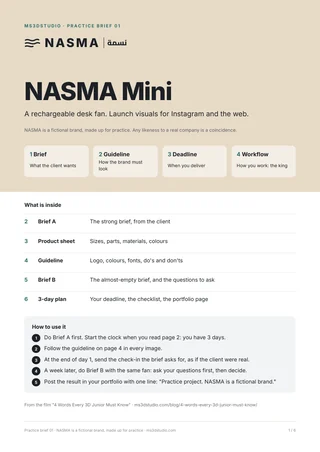 Practice brief: NASMA MiniStrong brief, product sheet, guideline, almost-empty brief and a 3-day plan. 6 pages.PDF · 771 KBDownload ↓
 The tough-client promptFor ChatGPT or Claude.TXT · 3 KBDownload ↓
 The Gemini guideline promptTurns a written guideline into slides you export as a PDF.TXT · 1 KBDownload ↓